Five of the Best China Open Finals
The China Open is back on the World Snooker Tour calendar after a seven-year absence — and tomorrow in Taiyuan, the 19th edition of one of snooker’s most prestigious ranking events gets underway. Before the first ball is struck, we’re looking back at five of the greatest China Open finals ever played. Matches that live in the memory not just for the scoreline, but for the context, the drama and the consequences they had for the wider snooker world.
5. Neil Robertson 11-4 Jack Lisowski | 2019 Final
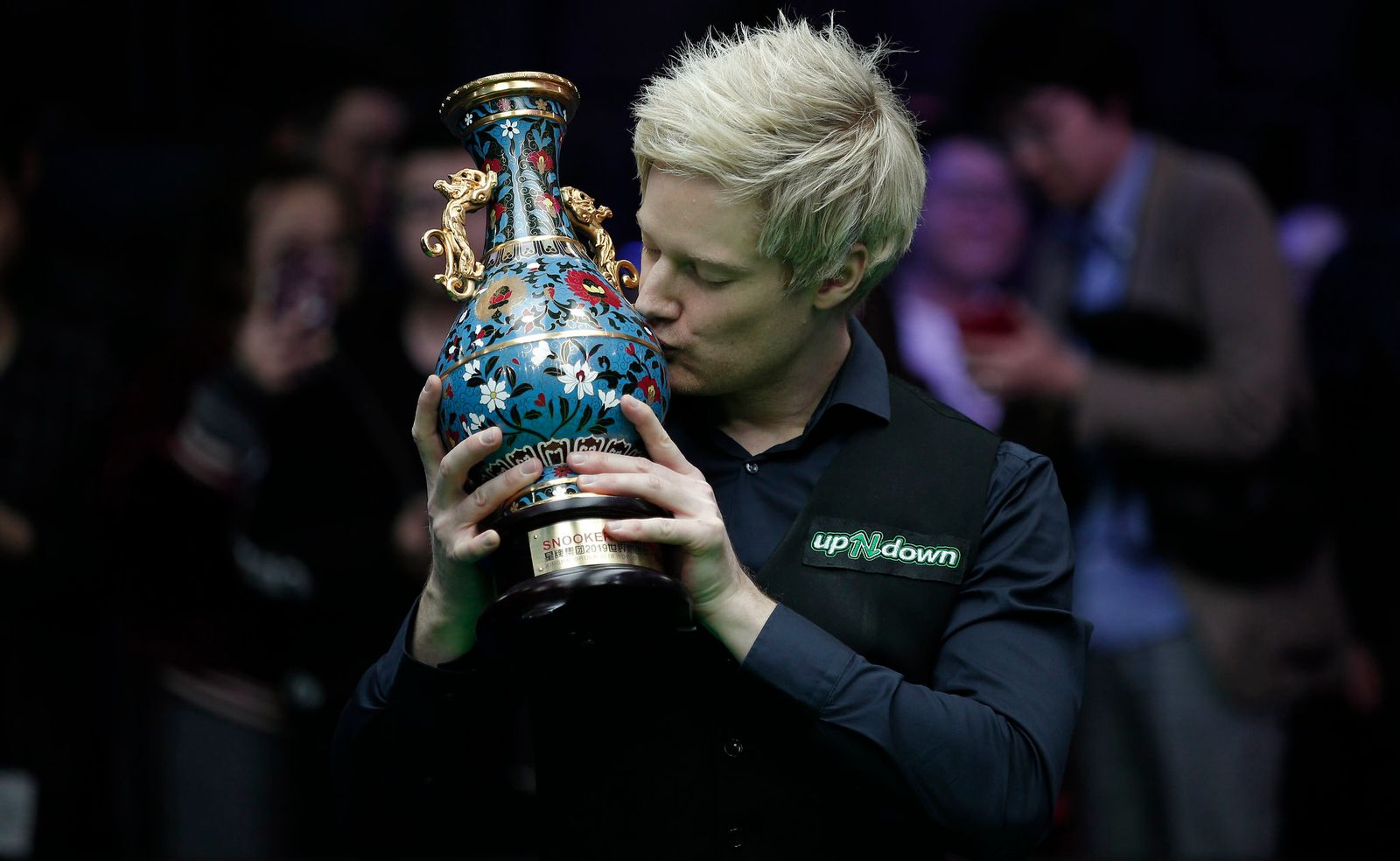
We start with the most recent final — and the most dominant performance in the tournament’s modern era. For Neil Robertson, the 2019 China Open represented his 16th ranking title and third of the season — a staggering return by any standard. For Lisowski, it was another final without the winner’s trophy, another step in a long wait for major silverware.
Both players arrived in the final in exceptional form. Lisowski had demolished Scott Donaldson 10-1 in the semi-finals — one of the most one-sided semi-final results in China Open history. Robertson beat Luca Brecel 10-7 with 11 breaks over 50 in the match. The standard going into the final was extraordinary.
What followed was a Robertson masterclass. He fired in breaks of 141, 100, 91, 86, 79, 74, 65, 60, 52 and 50 — ten breaks over 50 in a single final. Lisowski barely had a chance to settle. The 11-4 scoreline tells its own story.
For Robertson, it confirmed his status as the only player from outside the British Isles to have won all three Triple Crown events. The 2019 China Open was the latest chapter in one of the most remarkable careers in modern snooker.
“I’ve been playing really well all week and I’m proud of the way I finished the season,” said Robertson after lifting the trophy.
4. Mark Williams 9-8 Anthony Hamilton | 2002 Final
One of the most dramatic and heartbreaking finals in China Open history. Hamilton led 8-5 and appeared to be on the verge of his first major ranking title — the reward for years of consistent performances without silverware to show for it.
Williams turned it around. He won four frames in a row, took the deciding frame, and somehow came out on top 9-8. The remarkable detail: Williams never led the match until the very last ball of the final frame. He trailed for the entire match — and won it.
For Hamilton, the defeat was deeply symbolic. He would continue to wait for that elusive first ranking title — and wait, and wait — until finally winning the 2017 German Masters at the age of 43, fifteen years later. His only ranking title. In some ways, the 2002 China Open final shaped the entire arc of his career.
It is a story about how a single shot on the final ball can change everything. And about how long the wait can sometimes be.
3. Mark Williams 9-8 John Higgins | 2006 Final
The Class of 92 at their dramatic best. Two of snooker’s all-time greats — Williams and Higgins — meeting in a final that went the full distance, decided on the final ball.
For Williams, the victory was particularly meaningful. It ended a three-year ranking title drought stretching back to the 2003 LG Cup. Three years without a trophy is a long spell for a player of his quality. The China Open brought him back.
The final frame hung in the balance until the very end. Higgins had his opportunity and didn’t take it. Williams cleared to the pink and claimed the trophy — a moment that sounds simple in the telling but was anything but in the playing.
One overlooked fact: the highest break of the entire 2006 tournament (135) came from Ding Junhui — the previous year’s champion, who exited before the final. Ding would return to claim the title again in 2014.
2. Judd Trump 10-8 Mark Selby | 2011 Final
April 2011. Beijing. A 21-year-old Judd Trump plays in the first ranking event final of his career.
He defeated Mark Selby 10-8 — and became China Open champion. His first ranking title. And not just any first title: during that very final, Trump compiled his 100th career century break — a symbolic milestone that felt almost scripted.
The context makes the victory even more significant. Just one month later, Trump reached the World Championship final — and lost to John Higgins 15-18 in an unforgettable match. That year turned him from a promising talent into the defining player of his generation.
“China always feels like a special place for me. That’s where I first won something real,” Trump said later about the China Open.
Fifteen years on — 31 ranking titles, a world champion, the world number one. But it all started in Beijing in April 2011 with a 10-8 win over Selby.
A lesser-known detail: Selby had beaten Ding Junhui 6-3 in his semi-final — at home, in front of a Chinese crowd. Ding led 1-0 before Selby won five frames in a row. Not every home match goes to plan.
1. Ding Junhui 9-5 Stephen Hendry | 2005 Final
The most important moment in Chinese snooker history. Quite possibly one of the most important moments in the history of snooker as a whole.
3 April 2005. Beijing, Haidian Stadium. An 18-year-old Ding Junhui — just two days after his birthday — walks out for the final against seven-time world champion Stephen Hendry. Ding had entered the tournament as a wildcard — the organisers wanted to generate local interest by including a Chinese player. Nobody expected him to reach the final. Nobody expected him to win it.
Along the way, Ding had beaten Mark Davis, former world champion Peter Ebdon, Stuart Bingham, Marco Fu and Ken Doherty. This was no soft draw. He earned every step.
In the final, Ding fell behind 1-4. Hendry, the greatest player of his era, appeared to be in control. But the teenager refused to fold — winning eight of the next nine frames to win 9-5. The 1,500-strong crowd, including the Mayor of Beijing, rose to their feet.
110 million people watched the match on television in China — the most-watched snooker broadcast in history. For context: the famous 1985 World Championship final between Taylor and Davis — that legendary black-ball finish after midnight — drew 18.5 million viewers in Britain. The 2005 China Open final attracted nearly six times that audience.
“Ding’s a great talent. There’s no doubt about that and what he’s done in front of his home crowd is a real achievement. We’ll wait to see what happens next season but if he can eventually break into the top 16 I’m sure he’ll be there or thereabouts winning more tournaments in the future.” — Stephen Hendry
Hendry was right — but even he couldn’t have predicted the scale of what followed. After that final, snooker academies began opening across China. Sponsorship money flooded in. The China Open — which had been in danger of disappearing due to declining interest before 2005 — suddenly had a new life. The Shanghai Masters followed in 2007, the International Championship in 2012, and dozens of Chinese players began entering the professional tour.
Zhao Xintong, Wu Yize, Si Jiahui — an entire generation grew up watching an 18-year-old from Yixing beat Hendry. One final launched a revolution.
And one final detail that often gets overlooked: because Ding entered as a wildcard, he was not entitled to prize money under the rules at the time. He won the China Open — and left without a cheque. The reward came later, in the form of a career that final made possible.
The China Open 2026 begins tomorrow in Taiyuan — a new city, a revamped format and a record £1,200,000 prize fund. Who will write the next chapter in the tournament’s history? Follow all results and match updates at snooker.media.
About the Author