Rules of Snooker: A Complete Guide — From the Break-Off to the Final Black
Snooker has a reputation for being “hard to understand at first.” That’s partly true. But the core rules are surprisingly logical, and once explained step by step, everything falls into place.
This is the full rulebook — from how the balls are set up to the finest details of fouls and disputed situations. Read it through, and you’ll be able to not just watch a match but understand every moment of it.
The Objective and Starting a Frame
Snooker is played between two players. The goal is to score more points than your opponent by the end of a frame. Points are earned by potting balls into the pockets and from your opponent’s fouls. A match consists of a set number of frames. Whoever wins more frames wins the match.
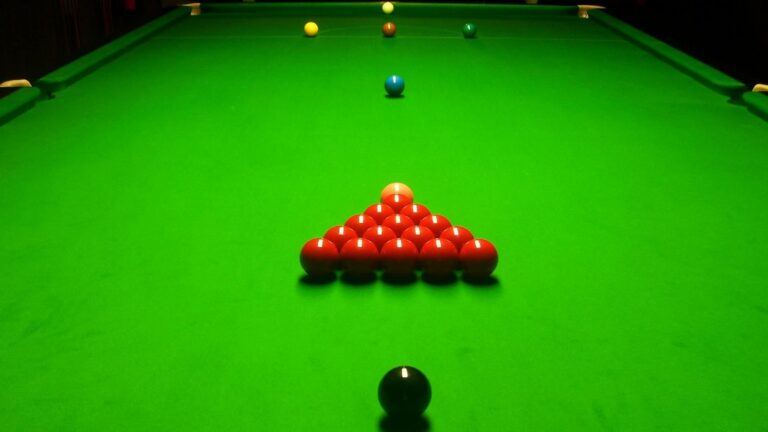
At the start of each frame, the balls are placed in defined positions:
- 15 red balls — in a triangle at the far end of the table;
- Black (7) — behind the triangle;
- Pink (6) — in front of the triangle;
- Blue (5) — dead centre of the table;
- Brown (4) — centre of the baulk line;
- Green (3) — left of the brown on the baulk line;
- Yellow (2) — right of the brown on the baulk line;
- White (cue ball) — the player places it anywhere within the “D,” a semicircle at the baulk end.
The Order of Play: How Balls Are Potted
This is the foundation of snooker’s rules. Understand this part and you understand the game.
Phase 1: Reds and Colours Alternate
The first part of a frame lasts as long as at least one red ball remains on the table:
- The player must strike the cue ball and pot a red. If successful — they continue.
- Now the player must pot any colour of their choice. If successful — they continue.
- The potted colour is returned to its spot (as long as reds remain).
- Back to a red.
The cycle repeats: red → colour → red → colour…
Each successful pot extends the player’s “break” — a running total of points scored without interruption. A miss or foul ends the break and passes play to the opponent.
Phase 2: Colours in Order
When all 15 reds have been potted, the final phase begins. The player on the table must pot the colours in strict ascending order:
Yellow (2) → Green (3) → Brown (4) → Blue (5) → Pink (6) → Black (7)
Now the colours stay down — they’re not re-spotted. The frame ends when the last ball (usually the black) is potted, or when a player concedes — acknowledging that the deficit is impossible to overcome.
How Points Are Scored
| Ball | Points |
|---|---|
| Red | 1 |
| Yellow | 2 |
| Green | 3 |
| Brown | 4 |
| Blue | 5 |
| Pink | 6 |
| Black | 7 |
The maximum possible score in a single frame is 147 points: 15 times (red + black = 8 points × 15 = 120), plus all colours in order (2+3+4+5+6+7 = 27). Total: 147. This is the “maximum break” — the rarest and most prized achievement in snooker.
What Is a Break?
A break is the sequence of consecutive points scored by a player in a single unbroken visit to the table. As long as the player keeps potting — the break grows. The moment they miss or commit a foul — the break ends and play passes to the opponent.
- Century break — a break of 100 points or more. A significant benchmark of skill. Top players accumulate hundreds or even thousands of centuries across their careers.
- Maximum break (147) — every ball potted in perfect sequence without a single miss. The rarest result in snooker.
Fouls: What’s Prohibited and What’s the Penalty
A foul is any violation of the rules. The opponent receives penalty points. The minimum penalty is 4 points, regardless of which ball was involved.
Common fouls include:
- Missing all balls — the cue ball fails to contact any object ball;
- Hitting the wrong ball — striking a colour when a red was required, or the wrong colour;
- Potting the cue ball — known as an “in-off.” The opponent receives penalty points and places the cue ball in the D;
- Jump shot — the cue ball jumps over another ball (except in specific circumstances);
- Touching a ball — with hand or cue, accidentally or deliberately;
- Playing before balls have stopped — the player must wait for all balls to come to rest.
The penalty corresponds to the value of the ball that should have been played — but never less than 4. So a foul while playing at the black (7) incurs a 7-point penalty. A foul while playing at a red (1) still costs 4.
The “Snooker” as a Tactical Play
A snooker is a situation where a player positions the cue ball so that the opponent cannot hit the required ball in a straight line — it’s hidden behind other balls. The opponent is trapped. If they can’t reach the target ball — even off a cushion — and hit the wrong ball instead, it’s a foul. When a player has been snookered after a foul by the opponent, they may be awarded a free ball.
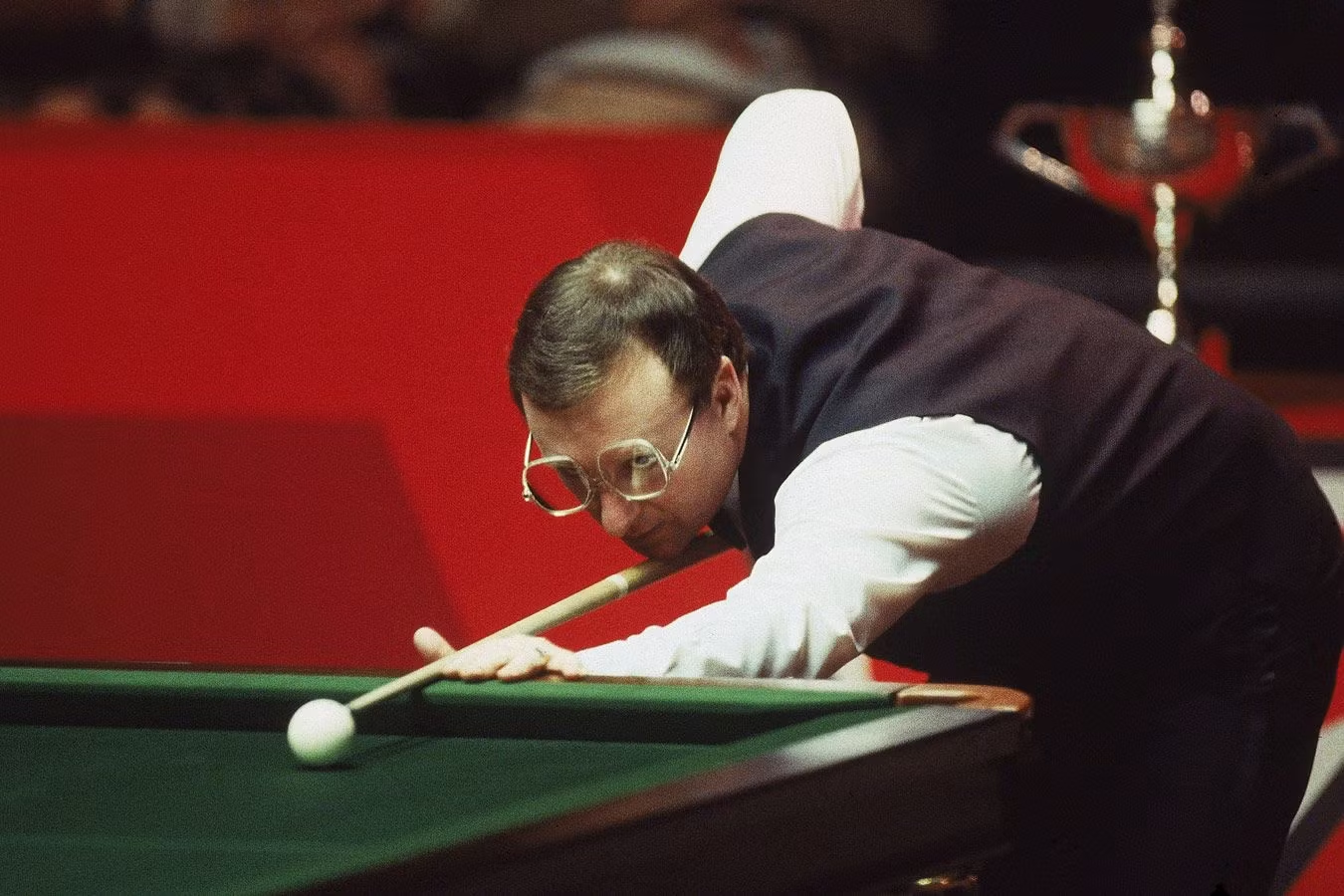
Tactical snookering is an entire layer of snooker mastery. Some players — Mark Selby is the prime example — build entire match strategies around safety play and snookers, grinding opponents down even when their potting isn’t at its sharpest.
Free Ball
If, after an opponent’s foul, a player is snookered on every ball they’re required to play, the referee awards a free ball. This means the player can nominate any other ball as a substitute for the one they can’t see. If the nominated free ball is potted, it scores the same as the ball it replaces (1 point if it substitutes for a red). Play then continues normally.
In theory, if a foul occurs at the very start of a frame when all balls are still on the table, and the player uses the free ball perfectly, the maximum break can reach 155 points instead of the usual 147. Nobody has ever achieved this. The closest is Ronnie O’Sullivan’s record break of 153 at the 2026 World Open.
Re-rack
If a situation arises where neither player can score enough points to change the result — or if the frame has become hopelessly deadlocked — the referee can call a re-rack. All balls are returned to their starting positions and the frame begins again from scratch.
End-of-Frame Scenarios
Special situations arise at the end of a frame:
- If the scores are level and only the black remains, play continues until one player pots the black or one commits a foul. Whoever pots the black — or whose opponent fouls — wins the frame.
- If one player leads by more than 7 points and only the black remains, the trailing player typically concedes the frame.
Match Formats
Matches vary in length depending on the tournament stage:
| Stage | Format |
|---|---|
| Qualifying | Best of 9–15 |
| First round | Best of 19 |
| Quarter-final | Best of 25 |
| Semi-final | Best of 33 |
| World Championship final | Best of 35 (first to 18) |
The World Championship final — first to 18 frames — is the longest match in snooker. It’s played over two days and can last 10–15 hours in total.
The Referee
The referee is a full participant in every match, standing beside the table throughout. Their duties include announcing the score after every pot, re-spotting colours, calling fouls and penalties, ruling on disputed situations, and checking ball positions at a player’s request.
Referees always wear formal attire — a dinner suit or business suit. They don’t commentate and show no emotion.
Frequently Asked Questions
Can you pot multiple reds with one shot?
Yes — each counts as a separate pot (1 point each). But you must still pot a colour before your next red.
Can a player deliberately miss?
No. A player must always play a shot. But they can play a “safety” — a shot designed to leave the opponent in a difficult position without attempting to pot a ball.
What is a “miss” call?
If the referee believes a player didn’t make a genuine effort to hit the required ball — perhaps deliberately missing to lay a snooker — they can call “miss.” The opponent then has the option to make the player replay the shot from the original position.
About the Author