History of Snooker
Every great game has its origin story. Football has the streets of Victorian England. Tennis has aristocratic lawns. Snooker has an officers’ mess in colonial India and a young lieutenant with nothing to do in the evening. That’s not an exaggeration. That’s exactly what happened.
Snooker was born in 1875 in the Indian city of Jabalpur — not in a basement club or a university hall, but around a billiard table where British officers had gathered after duty. And from that barracks party grew a game now watched by 450 million people in over 90 countries.
Part I. Birth: India, 1875
The British Army, the Heat, and Boredom
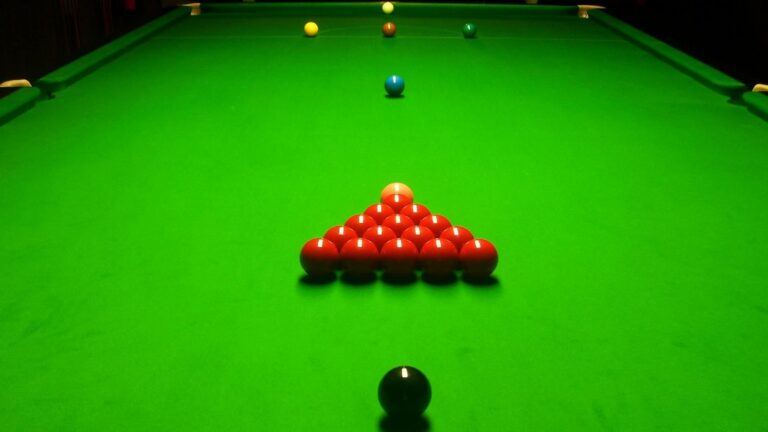
India, 1875. The city of Jabalpur (then Jubbulpore), Madhya Pradesh. British officers of the 11th Devonshire Regiment were serving in the heat, far from home, with limited entertainment. Billiards was already popular in the British Army. Officers played “pyramids” (15 red balls) and “black pool” (coloured balls with point values). But those games had grown stale.
Young Lieutenant Neville Chamberlain (not the future Prime Minister — a different man entirely) decided to change things.
Neville Chamberlain and the First Game of Snooker
Sir Neville Francis Fitzgerald Chamberlain was born on January 13, 1856. When he invented snooker, he wasn’t yet 20. His idea was simple: combine the rules of pyramids and black pool. Take the 15 reds from pyramids and add the coloured balls from black pool — yellow, green, brown, blue, pink, and black. Introduce a strict alternating order: first a red, then a colour, and so on.
The new game was an instant hit with the officers. It was more complex than ordinary billiards, required more thought and strategic planning — ideal for men accustomed to tactics and discipline.
Where Does the Name Come From?
“Snooker” in British Army slang of the time meant a new, inexperienced recruit — someone who had just arrived and didn’t know anything. The word had a distinctly dismissive tone.
One evening, an officer at the table played a poor shot. Chamberlain shouted: “Why, you’re a regular snooker!” The room laughed. The nickname stuck — first to the player, then to bad shots in general, and finally to the entire game. An insult became the name of a sport destined to conquer the world.
From Jabalpur to Ooty
The rules weren’t finalised immediately. In 1882, Chamberlain received a new posting — to the hill station of Ootacamund (Ooty) in the Nilgiri Mountains of southern India. It was at the Ooty Club that snooker took its more refined form. The club had a superb billiard table, made by Burroughes & Watts and shipped from London by sea. Snooker was played there daily, the rules were polished, and the game became a fully formed discipline.
That table still exists. The Ooty Club is still there. If you ever find yourself in that part of India, you can visit and see the place where snooker was born.
Part II. Return to Britain: 1885–1927
The breakthrough came in 1885 when British billiards champion John Roberts visited India, met Chamberlain, and learned the new game. Back in London, he spread it through the city’s gentleman’s clubs. In 1919, the Billiards Association & Control Club (BA&CC) codified the first official rules — including the re-spotted black rule that still applies today.
In 1927, player Joe Davis and promoter Bill Camkin organised the first official World Snooker Championship in Birmingham. Davis won — and then won the next 14 in a row. Until 1946, he was the undisputed king of snooker, virtually unchallenged. Davis didn’t just dominate at the table — he popularised the game, attracted audiences and sponsors, and developed the systematic positional play that forms the foundation of modern snooker. Before Davis, players mostly just hit balls. He showed that snooker is about thinking.
Part III. The Dark Ages and Revival: 1947–1968
After Davis retired from the championship, snooker struggled. The World Championship was held irregularly. Between 1958 and 1963, it wasn’t held at all. The game was sliding toward obscurity, seemingly destined to become a forgotten Victorian curiosity. And then colour television arrived.
Part IV. The Television Revolution: 1969–1985
In 1969, BBC launched Pot Black — specifically to showcase the capabilities of the new colour broadcasting system. The concept was brilliantly simple: which game looks best in colour? The one with bright, multicoloured balls on green baize. Snooker. Millions of British viewers saw the game at home for the first time — not in a club, not through a newspaper description, but live, in colour, in close-up. They fell in love. Pot Black aired annually and drew growing audiences every year.
In 1977, the World Championship found its permanent home — the Crucible Theatre in Sheffield. A compact 980-seat auditorium, built in 1971, became the most recognisable venue in cue sports.
Alex “Hurricane” Higgins turned snooker into a spectacle. He played fast, nervously, with the energy of a rock star. He won the World Championship in 1972 and 1982, but his real impact is measured in the millions of new viewers he brought to the game.
Then came April 28, 1985. The World Championship final. Dennis Taylor versus Steve Davis. The match went deep into the night. At 12:23 AM, Taylor potted the final black and won 18–17. 18.5 million Britons watched that moment live — a late-night BBC record that still stands. After that night, snooker was never a “niche game” again.
Part V. The Golden Era: Hendry, Davis, O’Sullivan
Steve Davis dominated the 1980s with six world titles and an ice-cold style. Then came the Scotsman.
Stephen Hendry — arguably the greatest player of the 1990s in any sport. Seven world titles, including five consecutive from 1992 to 1996. A record century count (775 — until O’Sullivan surpassed it).
And then came Ronnie. Ronnie O’Sullivan — seven world titles, 17 maximum breaks, 1,330+ centuries, the fastest 147 in history (5:20), and the record-breaking 153. He has been playing — and winning — into his 50s, turning snooker into art.
Part VI. Snooker Goes Global: China and New Horizons
In the 2000s, snooker began spreading rapidly in China. Over 60 million Chinese people play snooker. Television audiences for Chinese tournaments reach hundreds of millions. A new generation of Chinese stars emerged: Ding Junhui, then Zhao Xintong — the first Chinese world champion in 2025 — and Wu Yize, who followed in 2026.
The 2025/26 season was one of the richest in modern snooker history: Zhao as the first Chinese world champion, Wu’s breathtaking 18–17 final, O’Sullivan’s record 153 break, and a record 11 mainland Chinese players in the World Championship main draw. Snooker in 2026 is a global sport with seven major tournaments in China in a single season, events in Saudi Arabia and Hong Kong, and the traditional heartland in Britain.
Timeline: Key Dates in Snooker History
| Year | Event |
|---|---|
| 1875 | Neville Chamberlain invents snooker in Jabalpur, India |
| 1882 | Rules refined at the Ooty Club |
| 1885 | John Roberts brings the game to Britain |
| 1919 | First official rules codified (BA&CC) |
| 1927 | First World Championship — won by Joe Davis |
| 1946 | Davis retires after 15 titles |
| 1969 | BBC launches Pot Black — snooker on colour TV |
| 1977 | World Championship moves to the Crucible, Sheffield |
| 1985 | Taylor v Davis — 18.5 million viewers at midnight |
| 1990 | Stephen Hendry’s era begins |
| 1997 | O’Sullivan’s 147 in 5:20 at the World Championship |
| 2001 | O’Sullivan’s first world title |
| 2010s | China becomes snooker’s second home |
| 2022 | O’Sullivan — 7th title, oldest world champion (46) |
| 2025 | Zhao Xintong — first Chinese world champion |
| 2026 | Wu Yize — world champion; O’Sullivan — 153 break |
About the Author