How Many Balls Are in Snooker
One of the most common questions from anyone encountering snooker for the first time: “How many balls are actually on the table?” At first glance, there seem to be a lot — far more than in pool or eight-ball.
The answer: 22 balls. But this isn’t just “22 balls” — each one has its own name, a strictly defined position on the table, a point value, and a specific role in the game.
All 22 Balls at a Glance
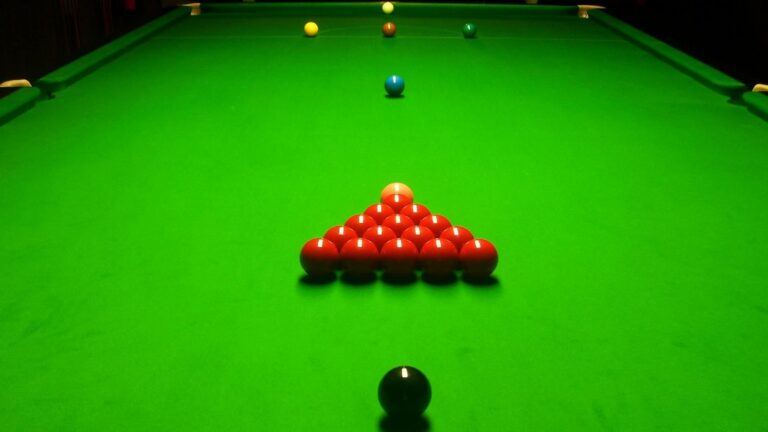
| Ball | Quantity | Colour | Points | Starting position |
|---|---|---|---|---|
| Cue ball | 1 | White | — | In the D (placed by the player) |
| Reds | 15 | Red | 1 each | In a triangle at the far end |
| Yellow | 1 | Yellow | 2 | Right side of the baulk line |
| Green | 1 | Green | 3 | Left side of the baulk line |
| Brown | 1 | Brown | 4 | Centre of the baulk line |
| Blue | 1 | Blue | 5 | Dead centre of the table |
| Pink | 1 | Pink | 6 | In front of the red triangle |
| Black | 1 | Black | 7 | Behind the triangle, far end |
Total: 1 cue ball + 15 reds + 6 colours = 22 balls.
The Cue Ball (White): The Most Important Ball on the Table
The white ball is the only one the player strikes with the cue. It has no point value — it’s the tool for everything else. After every shot, the cue ball stays on the table ready for the next. If it goes into a pocket — that’s a foul (known as an “in-off”), and the opponent receives penalty points.
What separates elite players from good ones is how they see the cue ball. They don’t see “the one you hit.” They see the first part of the next shot — where it will roll after it hits the target. Positional control of the cue ball is a science unto itself, refined over years of practice.
Diameter: 52.5 mm. Weight: approximately 140 g.
15 Red Balls: The Foundation of the Game
Fifteen red balls are the largest group on the table. Each is worth 1 point. At the start of a frame, they’re arranged in a triangle (the rack) at the far end of the table, a few centimetres from the pink. The first shot of the match — the break-off — splits this triangle apart.
Unlike the colours, reds don’t return to the table after being potted. Each potted red is gone for good. When all 15 reds have been potted, the final phase begins: the colours are potted in ascending order of value.
It’s possible to pot multiple reds with a single shot — and each one counts. If a player sends two or three reds into pockets with one stroke, they score 2 or 3 points accordingly and continue. But they must still pot a colour before the next red.
The Six Colours
Yellow (2 points) — the lowest-value colour and the first to be potted in the final phase. Positioned on the right end of the baulk line. While any reds remain on the table, the yellow is re-spotted after being potted. Only once all reds are gone does it stay down permanently.
Green (3 points) — sits on the left end of the baulk line, mirroring the yellow. Same re-spotting rules apply. In tactical situations, the green, yellow, and brown frequently become snookering tools — their position in the baulk area makes them ideal for laying traps.
Brown (4 points) — sits at the exact centre of the baulk line, between the yellow and green. It marks the midpoint of the bottom end of the table. Players often place the cue ball near the brown when breaking off, as it offers the best angle for the opening shot.
Blue (5 points) — occupies the most prominent position on the table: dead centre, equidistant from all four cushions. The blue appears in critical moments constantly. After potting a red, players frequently try to position the cue ball for the blue — it’s 5 points in a single shot. When the score is tight and only blue, pink, and black remain, the frame becomes a nerve-shredding calculation of who can pot what.
Pink (6 points) — positioned directly in front of the red triangle, between the reds and the blue. It’s a favourite choice after a red when building a big break. Red (1) + pink (6) = 7 points — efficient and often positionally convenient. In a maximum break, the pink is bypassed in favour of the black every time. Each time a player at 147 potential chooses the black over the pink, it’s a conscious decision to pursue perfection.
Black (7 points) — the queen of snooker. The highest-value ball and the last to be potted in a frame. It sits behind the red triangle at the far end of the table, meaning players often have to navigate through other balls to reach it. Whoever controls the black controls the scoreboard. When all other balls are potted, only the black remains — and the player who pots it wins the frame. In tight matches, everything comes down to one shot at the black.
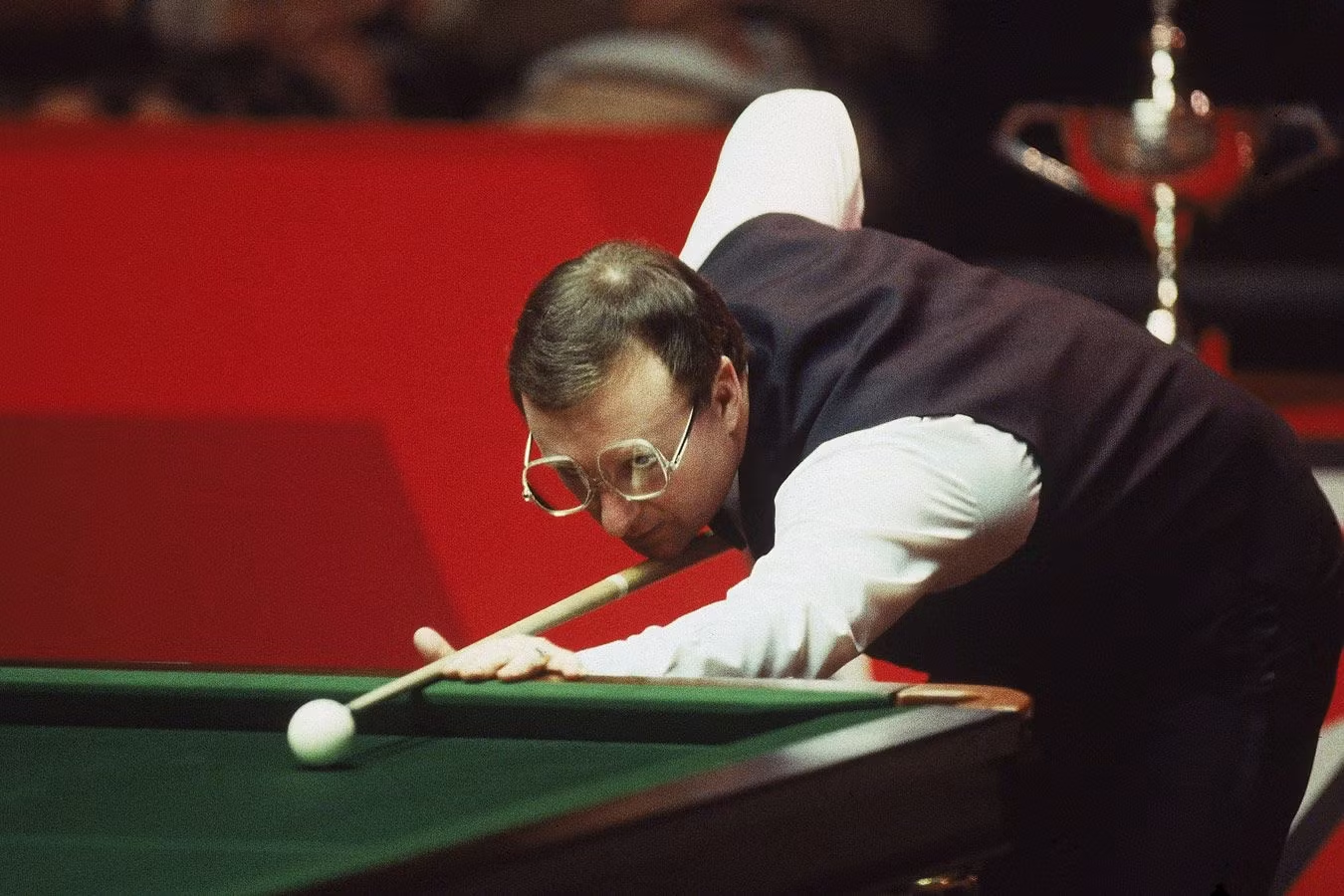
The most famous single shot in snooker history: Dennis Taylor potting the final black at 12:23 AM in the 1985 World Championship final, watched by 18.5 million viewers across the UK.
Why These Specific Colours?
The colours were established in the late 19th and early 20th centuries alongside the rules. But there’s practical logic behind them: the 15 reds needed the most “neutral” visible colour; yellow, green, and brown sit on the same line and must be clearly distinguishable from each other and from a distance; blue is the central ball and needs to stand out against the green baize; pink sits near the reds and must not be confused with them; and black — the final, most valuable ball — is the darkest colour on the table, symbolically and literally the last word.
Size and Material
Diameter: 52.5 mm — smaller than pool balls (57.15 mm). Material: hard phenolic resin. Until the mid-20th century, balls were made from ivory — a practice long since abandoned. Weight: approximately 140 g each. Official WST tournaments use balls manufactured by Aramith (Belgium) — the recognised standard for professional snooker.
The Maximum Break: The Maths
Now that you know the value of each ball, here’s how the maximum possible score in a single frame is calculated:
15 × (red 1 + black 7) = 15 × 8 = 120 points Yellow (2) + Green (3) + Brown (4) + Blue (5) + Pink (6) + Black (7) = 27 points Total: 147 points
If the opponent commits a foul and the player is awarded a free ball, the theoretical maximum rises to 155 — but nobody has ever achieved this. The highest break in official history is 153, made by Ronnie O’Sullivan at the 2026 World Open using a free ball after a foul by Ryan Day.
About the Author