China Open 2026 Results — August 10, 2026
The opening day of competitive action at the China Open 2026 delivered everything snooker fans could have wished for — dominant champion performances, a stunning whitewash, and a nail-biting decider that went down to the wire. Five matches were scheduled for August 10, one of which ended as a walkover, while the remaining four produced wildly different narratives. Here’s our comprehensive breakdown of every match.
M. Allen vs Y. Wafaei | Walkover (W/O)
The day began with a disappointment. The scheduled match between Mark Allen and Youssef Wafaei did not take place due to a walkover. One of the players was unable to appear, meaning the other advanced to the next round without striking a ball.
Mark Allen is one of snooker’s most entertaining players — a Masters champion and multiple ranking event winner whose aggressive, attacking style makes him must-watch television. Wafaei, meanwhile, has carved out a unique place in snooker history as the first Iranian-born professional on the World Snooker Tour, inspiring a new generation of players across the Middle East.
The reasons for the walkover were not officially disclosed at the time of publication. Such situations typically arise from health issues, travel complications, or personal circumstances. Regardless of the cause, it’s always a shame when a match of this calibre fails to materialise — both players and fans are left wanting.
Tournament Implications
While a walkover is never the way any player wants to progress, there is a silver lining: the advancing player receives a full day of rest before the next round. In a demanding tournament schedule, that extra recovery time can prove invaluable — particularly as the event deepens and matches become more gruelling.
N. Robertson 6:3 Binyu Ch. | Completed
Match Review
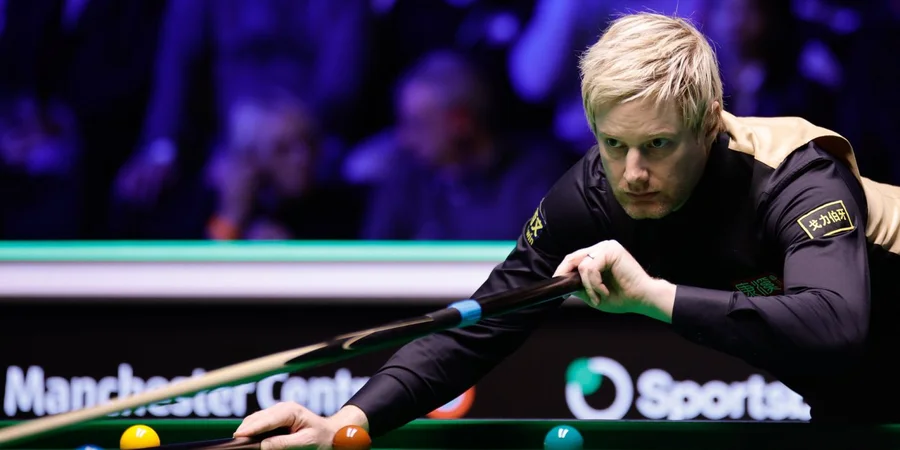
Neil Robertson delivered a typically commanding performance to dispatch Binyu Zhang 6-3 and book his place in the next round. The Australian, who has called Cambridge his home for over two decades, was in superb touch throughout — his long potting was devastating, his positional play was meticulous, and his temperament was that of a player who has been here before and expects to be here again.
Robertson’s story is one of snooker’s great adventures. A teenager from Melbourne who packed his bags and moved to the other side of the world to chase an improbable dream, he became the 2010 World Champion and has since accumulated one of the most impressive trophy cabinets in the modern game. His dedication to his craft borders on the obsessive — he is known for practising eight to ten hours a day during peak preparation — and that commitment was evident in every frame of this match.
How the Match Unfolded
Robertson seized control from the outset. His break-building was clinical, and he repeatedly punished Binyu’s mistakes with ruthless efficiency. The Australian’s ability to construct big breaks from seemingly innocuous positions is one of his defining qualities, and it was on full display here. Frame after frame, he manoeuvred the cue ball into position with the precision of a surgeon.
To his credit, Binyu managed to claim three frames — a respectable return against a player of Robertson’s calibre. The young Chinese player showed glimpses of genuine quality, particularly in his potting on the reds, but was ultimately outclassed in the tactical and positional departments. The experience gap was simply too wide to bridge.
Statistical Perspective
Robertson has historically performed well at Asian events, and his record at the China Open is particularly strong. His ability to adapt to local conditions — the lighting, humidity, cloth speed — is a hallmark of his professionalism. In this match, he looked entirely at home, as if he were playing on his practice table in Cambridge rather than competing 9,000 miles away.
Binyu’s three frames should not be dismissed. Taking three off Robertson in a ranking event is a creditable performance for any player outside the top 32, and it suggests the young Chinese player has the tools to compete at this level. This match will have been an invaluable education — you cannot replicate the experience of facing a former World Champion on the match table.
What’s Next for Robertson
Robertson advances in excellent form. His cue action looked grooved, his confidence appeared bulletproof, and his scoring was relentless. If he maintains this level, he will take some stopping. The Australian has made no secret of his desire to add more silverware this season, and this opening performance suggests he means business.
S. Jiahui 6:0 E. Yun | Completed
Match Review
The most one-sided result of the day — and it wasn’t even close. Si Jiahui produced a devastating display to whitewash Yun 6-0, delivering one of those performances that sends a tremor through the rest of the draw. A 6-0 scoreline at this level is not merely a comfortable win — it is a statement of absolute superiority.
A whitewash in professional snooker is a rare occurrence, even when the gulf in class is substantial. It requires total domination across every aspect of the game: potting, safety, positional play, and mental fortitude. It means winning every single frame without your opponent finding a single answer to anything you do. It is, in short, as close to perfection as snooker allows.
How It Happened
From the very first frame, Jiahui was in a different gear. His cueing was sharp and authoritative, his positional play was immaculate, and his mental concentration was unwavering. He attacked when opportunities presented themselves and defended with impenetrable precision when they didn’t. Yun was simply overwhelmed.
Yun appeared shellshocked from early on. Errors accumulated, confidence evaporated with each passing frame, and by the halfway point, the only remaining question was whether he could salvage a single frame of consolation. He couldn’t. Jiahui was utterly merciless, closing out the match with the same intensity he had shown from the start.
What This Result Means
A 6-0 victory is more than just a scoreline — it is a psychological weapon. Jiahui’s future opponents will see this result and understand exactly what they are up against. Such performances create an aura of invincibility that can be just as powerful as the snooker itself. Opponents walk to the table knowing that if they don’t bring their very best, they could be swept aside without trace.
There is also a significant practical advantage. A whitewash means minimal time at the table, which translates to fresher legs, a sharper mind, and more recovery time before the next match. In a tournament where physical and mental endurance are tested to their limits, this could prove to be a decisive edge in later rounds.
M. Selby 6:3 J. Pang | Completed
Match Review
Mark Selby — three-time World Champion, the “Jester from Leicester,” and one of the most mentally indestructible players in snooker history — recorded a professional 6-3 victory over Pang Junxu. The scoreline suggests comfort, though Pang certainly created moments of anxiety for the former world number one.
Selby is the kind of player who opponents dread drawing in any tournament. He is not the most flamboyant cueist, nor the most prolific century-maker, but his effectiveness is beyond question. His nickname may suggest levity, but behind the smile lurks one of the most ferocious competitors the sport has produced. He never gives up, never switches off, and never gifts opponents anything. Every point must be earned against Selby, and most opponents find the relentlessness of that challenge exhausting.
Tactical Breakdown
Selby built his victory on his trademark foundation: suffocating safety play, patient accumulation of opportunities, and ruthless punishing of errors. Pang managed to breach the wall three times, which speaks to his quality, but the overall narrative of the match was one of Selby’s controlled dominance.
A defining feature of Selby’s performance was his cue ball control in safety exchanges. He consistently left the cue ball in positions that made it extremely difficult for Pang to play aggressively, forcing the young Chinese player into errors under sustained pressure. Each time Pang cracked, Selby was there to capitalise with cold-blooded efficiency.
Pang — More Than Just a Supporting Actor
Pang’s performance deserves recognition in its own right. Three frames against Selby is a serious achievement. The three-time World Champion seldom allows lower-ranked opponents to win more than two frames, so Pang can hold his head high despite the overall defeat. He showed character, technique, and a genuine appetite for battle — all of which bode well for his development as a professional.
Selby and the China Open
The China Open has always been a tournament Selby takes seriously. His track record here includes deep runs and final appearances, and this convincing opening victory suggests his intentions for 2026 are no different. His ability to adapt his game to any opponent and any conditions remains his greatest asset, and it was on full display here.
K. Wilson 6:5 A. Hill | Completed
Match Review
The thriller of the day — and what a match it was. Kyren Wilson survived a monumental scare from Aaron Hill to win 6-5 in a contest that had everything: momentum swings, pressure pots, tactical battles, and a nerve-shredding decider. This was the kind of match that reminds you why snooker remains one of the most compelling individual sports in the world.
Wilson, the reigning World Champion from 2023, is one of the most complete players in modern snooker. His game has no obvious weaknesses — his potting is first-class, his safety is astute, his break-building is prolific, and his mental resilience has been tested and proven at the highest level. And yet, on this night, a 23-year-old Irishman pushed him to the absolute limit.
The Drama
The match unfolded like a rollercoaster. Wilson appeared to take control, then lost it. Hill would fall behind, then drag himself back. The scoreboard swung back and forth like a pendulum, and neither player could establish the decisive break that would settle the contest. The crowd in attendance were treated to a masterclass in competitive snooker — not always the prettiest, but always compelling.
Hill, at just 23 years of age, played with absolutely no fear of the World Champion’s reputation. His attacking play was bold, at times bordering on audacious — he went for pots that more experienced players would have avoided, choosing aggression over caution at critical moments. And remarkably, more often than not, he made them. His courage was extraordinary.
The climax arrived in the deciding 11th frame. The tension was palpable — you could have heard a pin drop in the arena. Every shot carried the weight of the entire match. Wilson, summoning all of his championship experience, managed to construct a crucial break that carried him across the line. But it was a victory earned in the trenches, not gifted by his opponent’s collapse.
Aaron Hill — A Star in the Making
Even in defeat, Hill earned a standing ovation. Taking the World Champion to a deciding frame at a major ranking event is an achievement that many established professionals never accomplish. The young Irishman demonstrated that he belongs at this level — his fearless approach, technical skill, and mental fortitude suggest a player with enormous potential.
For Hill, this match is priceless experience. He now knows what it feels like to stand toe-to-toe with a World Champion in a deciding frame, to feel the pressure of the biggest stage, and to understand exactly what separates the very best from the rest. These are lessons that no amount of practice can teach — they can only be learned in battle.
Wilson: A Lesson in Resilience
For Wilson, this match serves as a reminder that there are no easy victories in modern snooker. The new generation does not respect reputations — they come to compete, and they come to win. Wilson did what champions do: he found a way. It was not pretty, it was not comfortable, and it was not convincing — but it was a win, and wins are all that matter in tournament snooker.
The positive takeaway for Wilson is precisely that he was able to win on an off day. The hallmark of truly great players is their ability to grind out victories when their game is not firing on all cylinders. This ugly, scrappy, magnificent win could prove to be the spark that ignites a deeper run in the tournament.
Day Summary: Key Takeaways
Results at a Glance
| Match | Result | Status | Verdict |
|---|---|---|---|
| M. Allen vs Y. Wafaei | — | Walkover | Match did not take place |
| N. Robertson vs Binyu Ch. | 6-3 | Completed | Commanding Robertson win |
| S. Jiahui vs E. Yun | 6-0 | Completed | Whitewash of the day |
| M. Selby vs J. Pang | 6-3 | Completed | Controlled Selby victory |
| K. Wilson vs A. Hill | 6-5 | Completed | Thriller of the day — decided in the decider |
Trends and Observations
The favourites delivered. Every seeded player who took to the table fulfilled their obligation. Robertson, Selby, and Wilson — three former World Champions — all progressed, albeit with varying degrees of difficulty. This suggests the top players have arrived in China with serious intentions and are fully committed to competing for the title.
The young guns are fearless. Hill took Wilson to a deciding frame. Pang won three frames against Selby. Binyu claimed three against Robertson. The emerging generation of professionals are not intimidated by names and titles — they come to play, and they make the established stars fight for every frame. This is an immensely positive sign for the future health of the sport.
Si Jiahui is the dark horse. A 6-0 whitewash is a thunderous declaration of intent. If he can maintain anything close to this level, Jiahui could be the story of the tournament. His rivals will have taken note — and they will be wary.
Home support makes a difference. The Chinese players, even those who lost, showed fight, determination, and pride on their home soil. Jiahui’s performance, in particular, demonstrated what can happen when talent meets the motivation of performing in front of your own fans.
Looking Ahead
August 11 brings a fresh set of matches and fresh intrigue at the China Open 2026. The winners from Day 1 carry momentum, confidence, and the knowledge that they have done their jobs. The tournament is only beginning, and the best is yet to come.
About the Author