O'Sullivan reveals four-year battle with technical 'disease' that has transformed his game
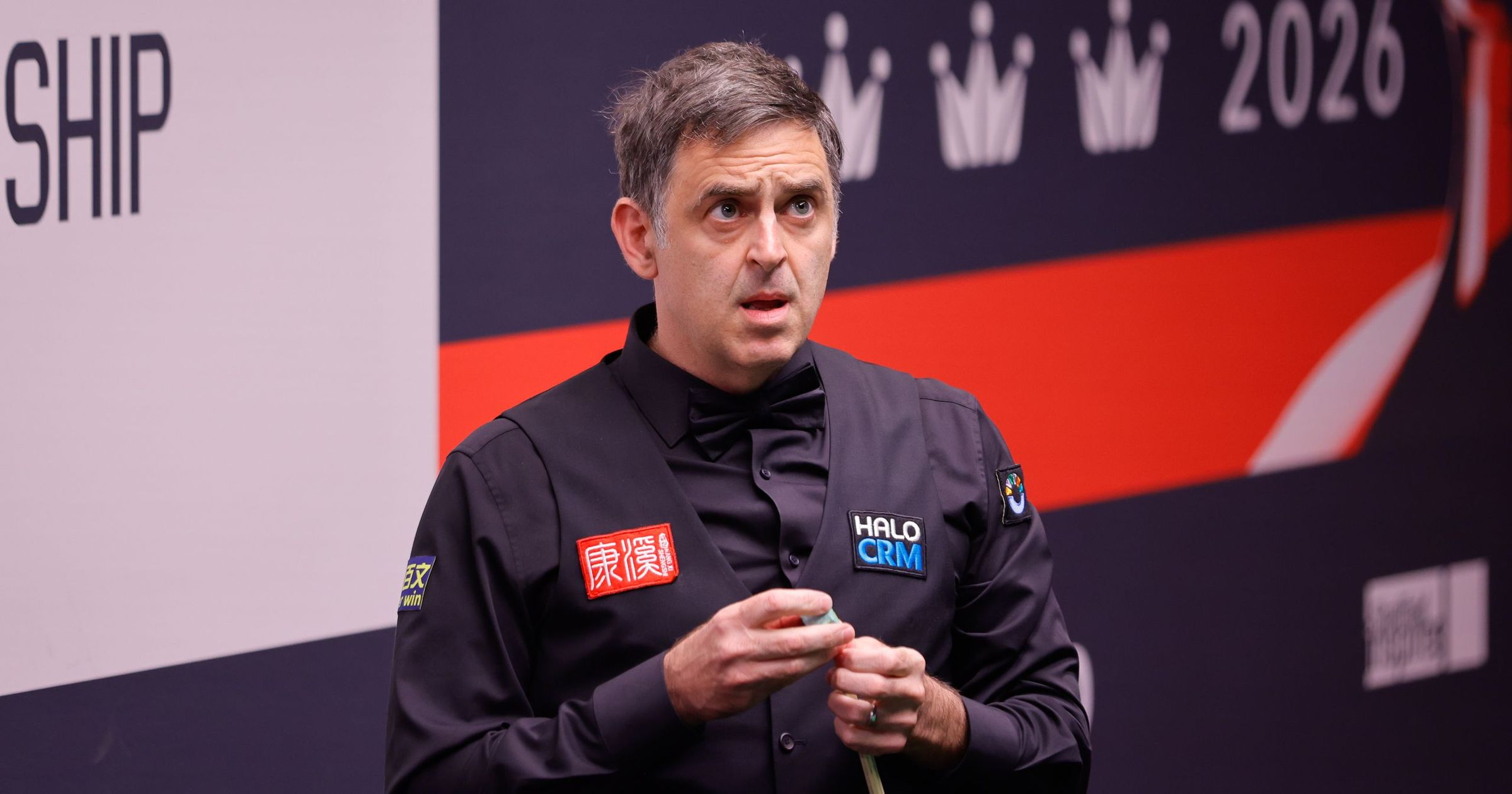
Seven-time World Champion Ronnie O’Sullivan has spoken with remarkable candour about the technical crisis that has haunted him for the past four years — a problem so persistent, so damaging, and so resistant to correction that he describes it with a single, devastating word: a disease.
In an interview with Xinhua conducted during the Wuhan Open last week, the 50-year-old laid bare the extent of a struggle that has fundamentally altered the way he plays snooker — and the way he feels about playing it.
The Problem: A Method That Turned Against Him
The roots of O’Sullivan’s crisis stretch back approximately six years. At 44, with seven World Championship titles and a record-breaking century haul already secured, he made a decision that most players at that stage of their careers would never consider: rather than relying on decades of muscle memory and instinct, he chose to learn an entirely new technique.
The method was called SightRight — a coaching system designed to help players align their eyes correctly with a shot. Initially, it appeared to work. But over time, something went wrong.
«A lot of people kind of thought it was good,» O’Sullivan explained. «It kind of turned against me after three or four years of doing it. So I’m trying to unlearn that, which is really hard to do.»
The consequence, in O’Sullivan’s own words, has been catastrophic for the foundational elements of his game.
«I call it a disease because it feels like the method that I took on has ruined me. I’ve got no cue power, got no sense of direction. I don’t know where the balls are going.»
Lost Anchors
For most professional snooker players, decades of experience provide a safety net — a set of reliable reference points to fall back on when something feels wrong. O’Sullivan says that safety net has been destroyed.
«As a player, you always have some anchors to hang onto. I used to have four or five where if one wasn’t working, I’d try another one, and then that would just get me going. But at the moment, I just have nothing. I haven’t for four years, so it’s just been like a nightmare.»
The word «nightmare» is not hyperbole. O’Sullivan has not won a ranking title since January 2024. His seventh World Championship — which many assumed would not be his last — was won in 2022. Before Wuhan, he had managed just one match victory at each of the Shanghai Masters and China Open this season. He withdrew from the British Open for medical reasons. He even described himself as «a very poor snooker player».
The Contradiction: Still Dangerous, Still Elite
And yet, the reality of O’Sullivan’s results tells a more complicated story than his self-assessment suggests. A player who claims to have no sense of direction still sits at world number 14. A player who calls his own technique ugly can still produce performances that stun pundits and opponents alike.
At the Wuhan Open, O’Sullivan’s run to the semi-finals included victories over Ali Carter (5-2), Yao Pengcheng (5-1), Stephen Maguire (5-2), and — most impressively — four-time World Champion Mark Selby (5-3), who is widely regarded as the form player on tour.
The Selby match was particularly revealing. O’Sullivan fell 2-0 behind before winning three frames in succession. Selby levelled at 3-3, but O’Sullivan finished the contest with breaks of 80 and 129 — the kind of scoring that most players can only dream of. Sky Sports described it as his most impressive performance of the season. O’Sullivan’s verdict was starkly different.
«To be honest, I don’t really have much hope to regain the kind of level that I was at before. But as it stands, it’s pretty ugly out there for me, and maybe ugly for you guys to watch me play.»
The Semi-Final Collapse
The day after beating Selby, the gap between O’Sullivan’s potential and his reality was exposed in brutal fashion. Facing China’s 24-year-old Chang Bingyu — a player O’Sullivan had coached approximately a decade ago — the seven-time champion appeared to lose his connection with the table entirely.
Critical pots caught the edge of the pocket and bounced away. At one point, a visibly frustrated O’Sullivan swung his cue through the air, sat down, and shook his head. He lost 6-3.
«Just embarrassing,» he told Xinhua. The disease, he added, had «come back big time.»
The View From the Other Side of the Table
The disconnect between O’Sullivan’s self-perception and how others see him is one of the most fascinating aspects of this story. For Wuhan spectator Chen Can, the O’Sullivan he watched bore little resemblance to the player O’Sullivan described.
«He beat Carter 5-2, downed Yao Pengcheng 5-1, knocked out Maguire 5-2 and defeated Selby 5-3,» Chen observed. «I feel he still has it. His attacking game is still smooth, and he can adjust quickly when he is in trouble.»
Some British fans online offered a blunter diagnosis, suggesting the real problem is something no technique can fix: age. O’Sullivan does not accept that explanation. At 50, an age when most players have long since retired, he is still dismantling his game and attempting to rebuild it from the ground up.
«I’ve been trying to do it for a year. I thought I was there, but I wasn’t, and now I’m kind of back to the drawing board.»
18 Months: The Deadline
O’Sullivan has set himself a clear timeline. He has consulted with Steve Davis and Stephen Hendry, both of whom told him they continued playing for roughly a decade after entering similar slumps. That counsel appears to have given him perspective — and a target.
«I give myself 18 months, maybe, to get into the 2028 World Championships, to see if I can get somewhere back to how I used to hit the ball. If I hit the ball half decent, then I can still win tournaments.»
An eighth World Championship in 2028 would give O’Sullivan the outright record for modern-era titles, surpassing Hendry’s seven. It would also be, by any measure, one of the most extraordinary achievements in sporting history — a 52-year-old reclaiming the summit of his sport after years of self-described technical agony.
«I’ll try my hardest,» he said. «We’ll have to wait and see.»
What It All Means
O’Sullivan’s situation is unique in professional snooker. No player of his stature has ever spoken so openly about losing the fundamental building blocks of their game — the cue power, the direction, the instinctive feel for the table that separated him from every other player for three decades. And no player has ever attempted such a radical reconstruction of their technique at such a late stage of their career.
The SightRight method, which gained significant attention in the snooker world several years ago, appears to have largely faded from the spotlight. O’Sullivan’s experience serves as a cautionary tale about the risks of overhauling a technique that was built on instinct and refined over a lifetime.
Whether he can unlearn what he has learned and rediscover the fluency that made him the most thrilling player the sport has ever seen remains an open question. But one thing is certain: at 50, Ronnie O’Sullivan is not going quietly. He is fighting — against his own game, against time, against the assumption that the greatest chapter of his career is already written.
About the Author