Women's Snooker Is Growing Fast — So Why Is the Top Level Still Mostly Male?
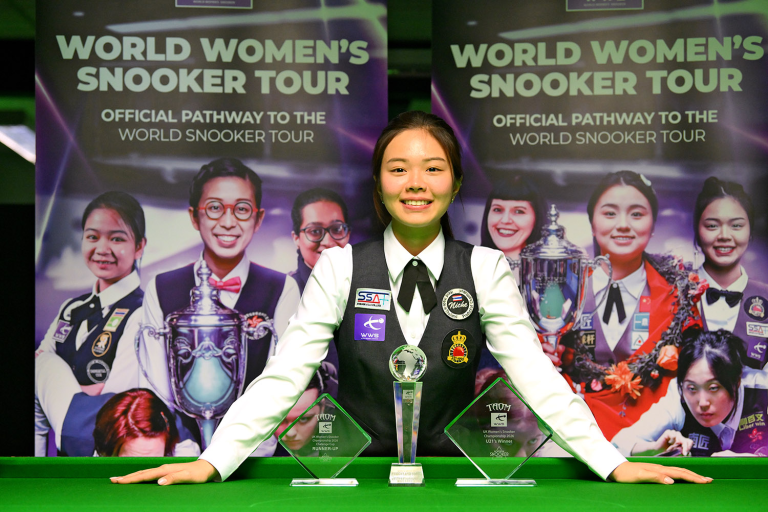
China’s Bai Yulu beat Reanne Evans 4-1 in the final of the Taom UK Women’s Snooker Championship, held at the Northern Snooker Centre in Leeds. It was her third consecutive win at this event, and it puts her back on top of the world rankings.
Across the three-day tournament, Bai lost only two frames in seven matches and put together three century breaks on the final day, topped by a run of 125 — enough to move her into second place on the sport’s all-time break list.
This was Bai’s ninth career ranking title, matching Thailand’s Mink Nutcharut, and her 18th straight match win at the UK Championship specifically. Evans, meanwhile, reached her 17th UK final — an extraordinary record for the event — and her second ranking final of the season, following a run to the World Championship final back in May.
The field for the tournament included every player in the current world top 10, and the standard of play reflected it: six century breaks were recorded across the weekend. Along the way to the final, Bai defeated three-time former champion Tessa Davidson, two-time finalist Rebecca Kenna, and Anupama Ramachandran, who herself had staged a comeback from 0-2 down against reigning world champion Panchaya Channoi in the quarter-finals. Evans’s path ran through Selina Dean, 17-year-old rising talent Liu Ziling, and outgoing world No.1 Ng On Yee in the semi-final.
The final itself swung early: Bai opened with a break of 103, Evans levelled at 1-1 with a 31, and Bai then pulled away with a 117 break before closing out the title with a 34 in the fifth frame.
Other results from the weekend: Thailand’s Narucha Phoemphul defended her Under-21 title (her eighth), while England’s Tessa Davidson defended the Seniors crown — her fourth in this event and 21st senior title overall since 2022, moving her within two of the all-time record held by Jenny Poulter. In the Challenge Cup for players eliminated before the final day, Latvia’s Anna Prisjažņuka took the win.
The tour now moves to the Australian Women’s Snooker Open, running 17–20 October in Sydney, with entries open via the ABSC website.
Why Aren’t There More Women at the Highest Level of Snooker?
Watch a snooker table for long enough and one thing becomes obvious: the balls don’t know who’s holding the cue. A pot into the middle pocket is exactly as hard whether a man or a woman is playing it. And yet at the very top of the professional game, the field is still overwhelmingly male. Why?
The lazy answer reaches for biology. The real answer is much more interesting — and far more encouraging.
An Open Door, Not a Locked One
Snooker doesn’t segregate its top tier by gender. The World Snooker Tour is open to everyone, and the WPBSA has been explicit that men and women can and do compete head-to-head. Women have played — and won matches — on the main professional tour, and have produced breaks that would earn respect from any player, of any gender.
The real issue isn’t ability. It’s access. Historically, far fewer girls than boys have had the coaching, competitive experience, encouragement, and financial backing needed to climb to the elite level. When one group starts generations behind, it’s no surprise the podium looks lopsided.
In March 2026, the WPBSA reaffirmed that all players — regardless of gender — can enter open tournaments, while World Women’s Snooker (WWS) runs a dedicated development pathway alongside it. A talented young woman doesn’t need a separate sport built for her; the route to the top already exists. The challenge is getting more girls onto it in the first place.
WWS currently counts over 170 players from 30 countries on its tour — real progress, but still a fraction of the pool historically available to men. And competitive sport is, to some extent, a numbers game: if a hundred thousand boys take a sport seriously and only a thousand girls do, the larger pool will simply produce more elite players. That’s a gap in opportunity, not talent.
1. The Gap Starts in Childhood
Elite players are rarely made in their twenties. The foundations — stance, cue action, judging pace, planning shots several moves ahead — are usually laid down years earlier, often before a player is even a teenager. By the time the best professionals reach major tournaments, they’ve typically logged thousands of hours at the table.
Historically, very few girls got that early start, which creates a self-reinforcing cycle: fewer girls playing leads to fewer junior competitors, which leads to fewer elite prospects, fewer professionals, fewer visible role models, and in turn fewer girls inspired to pick up a cue in the first place. Breaking that cycle takes more than good intentions — it needs venues, serious coaching, a real competition calendar, and parents who see snooker as a legitimate path, not a curiosity.
2. Role Models Matter More Than People Realise
Picture a ten-year-old girl who loves the game but has never seen a woman compete at the Crucible. It’s hard to aim for something you’ve never seen achieved. That’s why players like Reanne Evans, Ng On Yee, Mink Nutcharut, Bai Yulu, and Panchaya Channoi matter well beyond their match results — they’re proof of what’s possible.
Evans is the standard-bearer: the most decorated woman in the sport’s history, with a record 12 World Women’s Snooker Championship titles and 58 WWS ranking titles. In 2010 she became the first woman to qualify for the main stage of the World Snooker Championship — a genuine milestone, not a footnote.
Others have followed. Bai Yulu became the first Chinese player to win the World Women’s Championship, taking the title in both 2024 and 2025 and earning a WST tour card in the process; in 2025 she also set what was then the record break by a woman in a WST event, a 145. Then in 2026, 18-year-old Thai player Panchaya Channoi beat Evans 6-2 in the World Championship final to become the youngest women’s world champion since 1987.
Every one of these results puts a visible target in front of the next generation.
3. It’s Also a Money Problem
Turning professional is expensive — travel, accommodation, entry fees, coaching, equipment — and for a long time, prize money and sponsorship in the women’s game have lagged well behind the men’s circuit. That creates a hard choice for promising players: train and travel like a professional, or hold down a day job and squeeze in practice around it.
Two equally talented players can end up on very different trajectories purely because one has financial backing and the other doesn’t. That’s why investment matters — not just bigger cheques for established stars, but coaching stipends, youth programmes, travel support, and richer prize pools that widen the pipeline rather than just polishing the top of it.
4. Match Experience Can’t Be Faked
Practice and competition are not the same thing. A player who makes century breaks in an empty room can still crumble in a first-round match — pressure changes everything: the silence, the crowd, an opponent sitting across the table. A pot you’ve made five hundred times in practice can suddenly look impossible.
Learning to reset after a miss, close out a frame under pressure, and manage nerves only comes from doing it again and again in real competition. For a long time, the small size of the women’s player pool meant far fewer chances to build that experience. That’s exactly why a strong women’s tour isn’t a consolation prize — it’s the engine that builds those skills, and the WPBSA now formally recognises the WWS Tour as an official qualification route onto the WST. For the 2026/27 season, Channoi and Bai have both been nominated to compete on the WST alongside established professionals Ng On Yee and Evans — precisely the kind of bridge the sport needs.
5. Does Physical Difference Actually Matter?
Snooker isn’t decided by strength. Precision, timing, concentration, tactics, and consistency dominate. Average physical differences between men and women — height, reach, power — can occasionally make certain shots slightly more comfortable for one player than another, but they don’t explain a talent gap of this size. Plenty of top players, of any gender, succeed through touch and positional play rather than power.
The women’s game backs this up: Evans has twice made a break of 140, and Bai has scored at an elite level on the Open Pro Tour. Biology might shape a few edge cases; it doesn’t explain why so few girls take up the sport competitively in the first place.
6. What About Stance and Body Shape?
There’s an old claim that women’s body shape makes cueing technique harder. There’s little real basis for it. Every player — tall, short, broad, slim, long-armed or compact — adapts stance, bridge, and cue alignment to fit their own body. Good coaching finds what works for the individual rather than forcing everyone into an identical mould. The right question isn’t “does her body get in the way?” — it’s “has she had the coaching to find a technique that works for her?”
7. Starting Young Still Matters Most
Players who start serious training at eight or ten have a significant head start over those who begin at eighteen. That doesn’t rule out late starters — Nutcharut Wongharuthai is proof that talent can develop outside the usual timeline — but the earlier good coaching and real competition begin, the better the odds. If the sport wants more women at the top in a decade, it needs more girls at the table today, not next year.
8. The Talent Is Already There
None of this calls for easier tables, different rules, or lowered standards. What’s needed is a wider, better-supported pathway to the same standard everyone else is held to — and the evidence says it’s working.
Evans has dominated the women’s game for over twenty years. Ng On Yee became the first non-UK player to reach world No.1 in 2018. Mink Nutcharut took the top spot in 2023. Bai Yulu reached No.1 in 2026 as a two-time world champion. And in May 2026, 18-year-old Panchaya Channoi beat three former world champions on her way to the title. This is not a shallow talent pool — it’s a growing one.
9. The Sport Is Getting More Global
Current WWS rankings include players from England, China, Hong Kong, Thailand, India, Mongolia, Australia, Latvia, and Iran, among others. Snooker gets stronger as talent gets discovered in more places, and Bai Yulu’s rise is a good example of what investment and local interest can produce. The 2026 World Women’s Championship was staged at a purpose-built venue in Dongguan Changping, secured through 2031 — the kind of long-term infrastructure that builds a sport rather than just marketing it.
10. What Actually Moves the Needle
There’s no single fix — the whole pathway needs strengthening at once:
- More girls at grassroots level, through schools and clubs, before old stereotypes take hold
- Better access to coaching that can spot potential early and build proper fundamentals
- More visible role models, since every major appearance by Evans, Bai, Channoi, Ng On Yee, or Nutcharut tells a young player “I could do that too”
- Stronger financial support, so more women can train like professionals rather than fitting it around a job
- More media coverage that tells the human stories behind the matches — ambition, pressure, a teenager chasing a title, a veteran refusing to quit
The Real Question Isn’t Men vs. Women
The point was never to prove one gender better than the other. The real question is how much talent has gone undiscovered simply because the opportunity to develop it never existed — and we won’t know the answer until it does. If more girls start at eight or nine, get real coaching, compete regularly, and grow up watching women succeed on the big stages, the talent pool will only deepen.
Somewhere, right now, a future champion may be eight years old, holding a cue for the first time, quietly thrilled that the cue ball rolled exactly where she wanted it to. Nobody’s noticed her yet. That’s exactly where the opportunity lies.
Choosing a Snooker Cue: What Actually Matters for Female Players
There’s no such thing as a cue “made for women” — a good cue fits the player, not a label. Many experienced female players use standard 57″ or 58″ cues without issue. The better question isn’t “which cue is for me?” but “which cue lets me play naturally, comfortably, and consistently?”
- Length and stance. A standard cue runs 57–58 inches, which suits most adults. Smaller players — including many juniors and beginners — may find a 56-inch cue more comfortable while they build a stable stance and bridge. Signs a shorter cue might help: struggling to hold a comfortable stance, the butt getting in the way of your backswing, crowding the table on certain shots, or losing focus on the shot because you’re wrestling with the cue itself. Junior cues (51″ or 53″) are often a better starting point for younger or smaller players than jumping straight to full length.
- Weight. There’s no ideal weight tied to gender — it’s personal. A heavier cue can feel solid and planted; a lighter one can feel more responsive. What matters is whether you can deliver a smooth, controlled stroke: too heavy and you risk tension in the arm and grip; too light and longer shots can feel unstable. For developing players, balance and control matter more than the number on the scale.
- Tip size. A 9.5mm tip suits players of any gender in traditional snooker — it’s narrower than many pool cue tips, giving precise contact for spin, stun, and delicate positional shots. The right tip size comes down to the game you’re playing, not who’s playing it. Players wanting a different feel might also look at a professionally fitted tip upgrade, such as an ELK Master Tip.
About the Author